Potholes and Ruts Back Within Months? What a Proper Base Should Have
Quick Answer: Potholes and ruts return within months when a gravel driveway never had an engineered base to begin with — usually just a single layer of stone dumped over bare clay. A base built to hold up needs three distinct layers of properly sized aggregate, each compacted before the next goes down, along with a geotextile fabric separation layer over soft or clay-heavy subgrade and a crowned surface that sheds water to the sides instead of letting it pool in the wheel path. Skipping the separation fabric lets fine clay particles pump up into the stone under traffic, which is one of the most common reasons a freshly graded driveway looks fine for a few weeks and then sinks right back into ruts. Get the layering, compaction, and drainage right once, and the surface stops needing the same repair every spring.
You've raked the ruts smooth, dumped a load of fresh gravel over the low spots, and for a couple of weeks the driveway looks the way it did the day it was put in. Then a few good rainstorms roll through off the mountains, the delivery truck and your own vehicles keep hitting the same tire paths, and by the next month you're standing in the same spot with a rake again, looking at the same two ruts running up toward the house. If that cycle sounds familiar, the surface gravel was never really the problem.
Somewhere under your driveway, on a lot in Jonesborough, Gray, or up toward Limestone and Chuckey, there's a base that was never built to actually carry a vehicle — and no amount of fresh stone on top is going to fix what's happening underneath it.
Northeast Tennessee doesn't make this easy. Most rural lots here sit on red clay, and a lot of driveways run at some kind of grade instead of dead flat. Add rainfall that tends to show up in heavy bursts rather than gentle showers, and a base here has to do more work than one on a flat, sandy lot somewhere else. What follows is what an engineered gravel base actually needs, layer by layer, and why cutting any one of those layers out is what brings the potholes back.
Why the Same Spots Keep Breaking Down
A gravel driveway that fails in the same spots over and over almost always has one root issue: there was never a real base separating the surface stone from the dirt underneath it. When a truckload of gravel gets spread directly over native clay soil with no preparation, the stone and the clay are in constant contact. Every time a vehicle rolls over that spot, the weight presses the stone down into the soft clay instead of sitting on top of a stable platform.
Vehicle loads don't spread out evenly the moment they hit the ground. A tire's weight travels downward through the gravel in a narrowing cone, which means the load concentrates on a fairly small area of the soil directly beneath the wheel path. Without a properly built base to spread that load out first, all of that pressure lands on a small patch of clay that simply can't take it, especially once rain has softened it. The clay deforms, the stone above it follows the same path downward, and a rut forms. Run that cycle for a season and you get the same trench, over and over, in the exact spot where tires travel.
There's a second failure mode that's specific to clay-heavy ground like most of what you'll find around Johnson City, Erwin, and Unicoi County. Without a separation layer between the subgrade and the aggregate, repeated traffic and rain pump fine clay particles up into the gravel from below. This mixes fines into what should be an open, well-draining layer of stone, clogging the voids between the rock and turning what was supposed to be a load-bearing layer into something closer to mud with rocks in it. But no amount of raking fresh gravel over the top solves it, because the failure is happening below the surface you can see.
What a Proper Base Should Have
A driveway that holds its shape season after season is built in layers, not dumped in one pass. Each layer has a specific job, and skipping one usually means the layer above it fails early.
Subgrade Preparation
Before any stone goes down, the native soil needs to be graded to the correct slope and compacted. Soft spots, topsoil, and organic material get stripped out down to firm ground — none of that belongs under a load-bearing surface, because it compresses unevenly over time and creates the low spots where water and weight both concentrate.
Geotextile Fabric Separation
On clay or consistently damp subgrade, a woven geotextile fabric goes down directly over the prepared soil before any stone is placed. This layer keeps the clay and the aggregate from mixing under traffic, lets water pass through into the ground below instead of pooling at the interface, and adds a measure of reinforcement at the point where the base meets the native soil. Seams in the fabric should overlap by at least a foot to keep the barrier continuous. On a driveway with well-drained, sandy-gravelly soil, this layer matters less — but most lots in this part of Tennessee are sitting on enough clay that it's worth the extra step.
Subbase
This is the structural foundation, typically 4 to 6 inches of compacted, angular clean stone. On firmer, well-drained soil, the lower end of that range is usually enough; on clay subgrade, the subbase should run toward 6 to 8 inches. This layer's large particle size leaves open voids between the stones even after compaction, which is what lets water drain through rather than collecting at the base.
Base Course
On top of the subbase sits 3 to 4 inches of crusher run — a mix of crushed stone and stone dust that compacts into a dense, stable platform. Unlike the subbase, this layer is meant to compact tight rather than stay open, because it's the working surface the driveway's stability depends on day to day.
Surface Course
The finish layer — 2 to 3 inches of whichever gravel you've chosen for looks and feel, whether that's crushed limestone, crusher run, or a decorative stone — sits on top of the base course. This is the layer most people think of as "the driveway," but it's carrying the least structural weight of the three. It's cosmetic and functional for traction, not the layer doing the heavy lifting.
Put together, a standard residential base on moderate soil runs roughly 9 to 13 compacted inches total. On heavier clay, or where the driveway sees regular truck or trailer traffic, that number climbs toward 12 to 16 inches. Every one of those layers has to be compacted separately before the next goes on — spreading it all at once and compacting only the top few inches leaves loose, uncompacted material underneath that will settle out later, which is exactly how a driveway that looked solid at installation starts rutting six months in.
Tip: Ask whoever's building or rebuilding your base what lift thickness they're compacting in. Lose material should go down in layers no more than 4 to 6 inches deep before each pass with a plate compactor — a compactor's vibration only reaches so far into loose stone, so a single 10-inch lift dumped and rolled once leaves the bottom half essentially untouched.
Crown, Slope, and Where the Water Actually Needs to Go
Layering the base correctly solves half the problem. The other half is getting water off the surface before it has a chance to soften anything underneath. This is where hill country driveways run into trouble that a flat suburban lot never has to deal with.
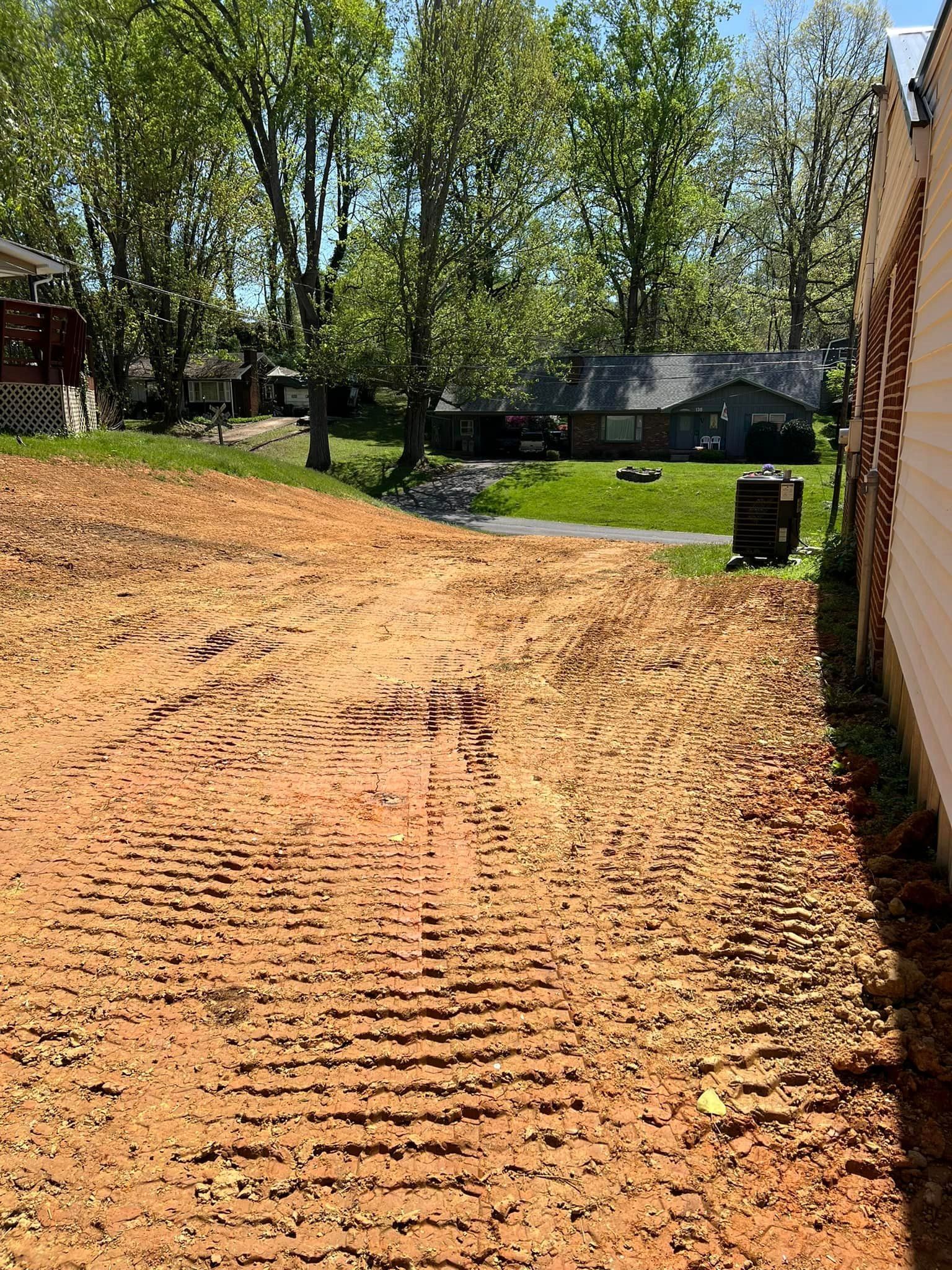
A driveway surface should have a slight crown — higher in the center than at the edges — so rain sheds to both sides instead of running straight down the middle of the wheel path. On a sloped driveway, that crown works together with the overall grade of the drive: water should always have somewhere to go that isn't pooling in a low spot or funneling straight down the tire ruts. On many of the properties around Jonesborough and Greeneville, the driveway itself is the path of least resistance for water coming off higher ground, and if there's no ditch, culvert, or defined runoff path alongside it, the driveway becomes the drainage system by default.
Ditches alongside the driveway, a culvert where it crosses a low point, a French drain in a spot that stays chronically wet — these all serve the same purpose: keeping water from sitting against or soaking into the base. Saturated clay loses bearing capacity fast, and a soft subgrade undermines every layer stacked on top of it, no matter how well those layers were compacted going in.
Water finds the easiest path downhill. On a lot built into a slope, that path is often the driveway itself.
Grading isn't a one-time job, either. A gravel surface loses its crown gradually as traffic pushes material toward the edges and low points fill in with loose stone. Regrading every year or so, especially after a hard winter or a stretch of heavy spring rain, restores the shape that keeps water moving instead of collecting.
Matching the Base to Your Site's Soil and Traffic
Not every driveway needs the same base, and building every job to a single spec either wastes money on ground that didn't need it or leaves a heavier-use driveway under-built. Two variables drive most of the difference: what's under the driveway, and what's driving on it.
Soil type changes subbase depth. Firm, well-drained sandy-gravelly ground may need a leaner base. Clay and loam require the fuller 6- to 8-inch subbase, while wet or poorly drained ground needs drainage addressed before stone is installed before construction begins.
Traffic loading changes total thickness. A driveway serving passenger vehicles needs less structure than one carrying dump trucks, RVs, or farm equipment. Heavier, frequent loads require thicker subbase and base courses to distribute weight across the subgrade properly over time.
Slope changes how compaction and drainage interact. Graded driveways move water faster, increasing erosion and washout risks. Meaningful slopes may require better crowning, more frequent regrading, or cross-drains and water bars to slow runoff and protect gravel during heavy rainfall.
Warning: Building or rebuilding a base on a sloped clay lot without addressing drainage first is one of the most common ways a repair fails within a single season. Fresh gravel and proper compaction won't hold if water is still concentrating against the base every time it rains — the drainage work has to happen alongside the base work, not as an afterthought once the surface looks finished.
Frequently Asked Questions
How deep should the base be under a gravel driveway on clay soil?
Plan for a 6 to 8 inch subbase of compacted clean stone under a 3 to 4 inch base course. Total compacted depth lands around 12 to 16 inches, depending on traffic and soil softness.
What's the difference between crusher run and clean stone for a driveway base?
Clean stone like #57 stays open and drains freely, so it suits the subbase. Crusher run contains stone dust that binds under compaction into a dense, firm platform, which is what the base course needs.
Does a gravel driveway on a slope need a deeper base than a flat one?
Not necessarily, but slopes demand more from drainage and compaction. Water moves faster and erodes more, so a sloped driveway needs a deliberate crown, working ditches or cross drains, and careful compaction at every lift.
How do I know if my driveway needs geotextile fabric under the gravel?
If your soil is clay, loam, or stays soft and muddy after rain, fabric is worth it. It keeps fine soil from migrating into the stone. Firm, sandy, well drained ground benefits less from it.
Why do ruts keep forming in the exact same spot every time it rains?
The subgrade under that spot has usually lost its bearing capacity, often from standing water or contaminated stone. Tires follow the same path, so fresh gravel only masks the failure for a few weeks.
How often should a gravel driveway base be checked or refreshed?
A well built base needs real attention only every several years. The surface benefits from regrading once or twice a year to restore the crown, and checking after heavy rain or winter catches early rutting.
A Solid Base Keeps Your Driveway Smooth Longer
Potholes and ruts that return every few months are rarely a surface problem. They point to a base that was never built to carry weight, with no separation fabric, no compacted layers, and no plan for water. Get those three things right and the driveway stops asking for the same repair every spring. Fresh gravel only helps when the stone underneath is stable, so the real work happens below the surface, layer by layer, long before the final coat of stone goes down.
At Absolute One Properties, we have built and rebuilt gravel driveways in Jonesborough, TN, and the surrounding communities for 30 years, so we know how hard red clay and heavy mountain rain can be on a driveway. A base with proper layers, good compaction, and a crown that sheds water can handle that punishment season after season. Build it right once, and the ruts stay away, the surface holds its shape, and the driveway simply does its job.